
Quick Summary
Wedge anchors rely on an expansion clip pressing against the hole wall to hold, making them a dependable, cost-effective choice for uncracked concrete and general structural work. Undercut anchors cut or key into a widened section at the bottom of the hole, creating a mechanical interlock that holds up under cracked concrete and higher seismic or tension loads. Choosing between undercut anchors vs wedge anchors comes down to the load rating, code requirements, and the concrete's likelihood of cracking under stress.
Anyone comparing undercut anchors vs. wedge anchors is deciding how much holding power a project needs against how much installation effort makes sense for the job. Both anchor types secure hardware, steel, and equipment into concrete, but they grip the material in different ways.
Wedge anchors expand against the hole wall to create friction-based holding power, while undercut anchors cut a mechanical key into the base of the hole for a connection that doesn't rely on friction alone. That difference in mechanism changes where each anchor performs best.
What Is a Wedge Anchor?
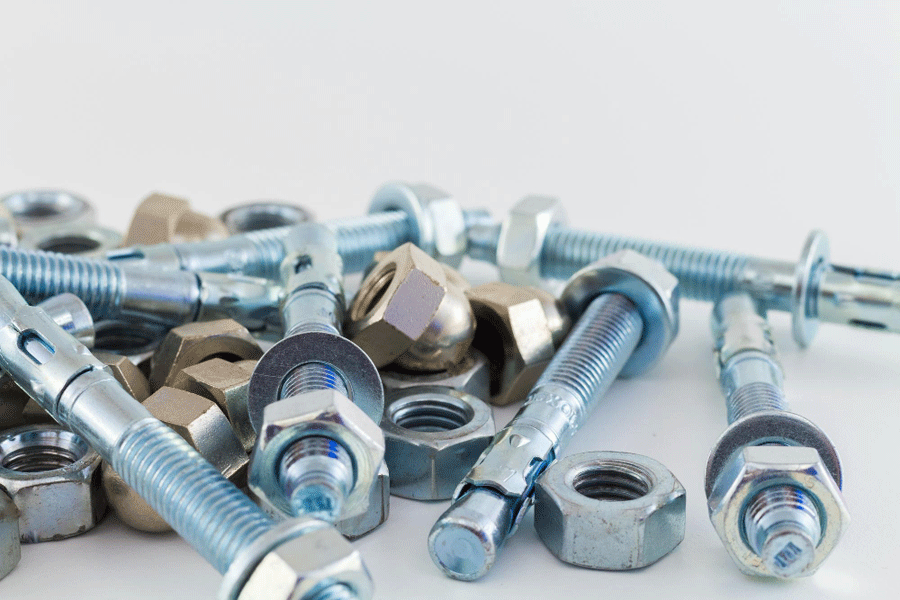
Wedge anchors are mechanical expansion fasteners built from a threaded stud, nut, washer, and expansion clip. Tightening the nut pulls the clip outward against the sides of a pre-drilled hole, and friction from that outward pressure holds the anchor in place.
They're widely used across construction for general structural connections in solid, uncracked concrete, and they cover most everyday anchoring needs at a reasonable cost.
What Is an Undercut Anchor?
Undercut anchors work differently. During installation, the anchor either uses a special drill bit to carve a widened, cone-shaped section at the bottom of the hole, or the anchor itself cuts that undercut as it's set with a torque tool.
Once seated, the anchor's expanded base locks physically into that undercut shape, creating a mechanical interlock rather than a friction hold. This design gives undercut anchors higher pull-out resistance and steadier performance in cracked concrete than a standard wedge anchor provides.
Key Differences Between Undercut Anchors and Wedge Anchors
- Holding mechanism
Wedge anchors hold through friction from an expansion clip pressed against the hole wall. Undercut anchors hold through a physical, keyed connection at the bottom of the hole, which doesn't depend on friction to carry load.
- Cracked concrete performance
Wedge anchors can lose some holding capacity if a crack forms through the anchor location, since the friction connection weakens. Undercut anchors hold their rated capacity even in cracked concrete, which is why they carry seismic and life-safety approvals that many wedge anchors don't.
- Installation
Wedge anchors install with a standard hammer drill, bit, and wrench, making them quick to set on most job sites. Undercut anchors need a specialized drill bit or setting tool to form the undercut correctly, along with more careful attention to hole depth and cleanliness.
- Cost
Wedge anchors cost less per unit and don't require special tooling, which keeps them the go-to for everyday structural work. Undercut anchors cost more upfront and often call for specific tools, but that investment pays off on projects where failure isn't an option.
- Load capacity
Undercut anchors generally outperform wedge anchors in both tension and shear, especially near a concrete edge or in thinner slabs where a wedge anchor's expansion force could cause cracking.
When to Use Wedge Anchors
Wedge anchors handle most general structural work well: handrails, equipment mounts, racking, ledger boards, and connections in solid, uncracked concrete where the load falls within standard ratings.
For the majority of construction and industrial anchoring needs, a wedge anchor gets the job done at a lower cost and with a faster install.
When to Use Undercut Anchors
Undercut anchors earn their keep on high-stakes connections: seismic-rated structural steel, curtain wall systems, fall protection anchor points, and any application where an engineer's spec calls for anchorage in cracked concrete or near an edge where a wedge anchor's expansion force risks a blowout.
Life-safety equipment and connections governed by strict code requirements often specify an undercut anchor by name.
Get Dependable Anchoring Solutions at Factory Direct Supply
Factory Direct Supply has supplied contractors across Florida with dependable anchoring products since 2000, including a wide range of wedge anchors from Simpson Strong-Tie and DeWALT in sizes built for everyday structural work.
Our team can help match the anchor, diameter, and length to your load and base material, and orders over $50 ship free. If a project calls for a specialized anchor type outside our standard lineup, our custom order team is set up to track it down and get it to your job site. Contact Factory Direct Supply today and get anchoring hardware you can count on.